
Last updated: June 08, 2026
Knowing the right size of your carry-on bag is essential when you are traveling both domestically and internationally! It might be too late once you’re at the airport. Just imagine! You’ve finally decided what to pack in your carry-on baggage and have safely made it to the airport to face your first challenge: the Bag Sizer. You would rather not be the person seen furiously smashing his bag into the measuring rack in a futile attempt to make it fit. Or that other guy who has miraculously managed to fit his carry-on into the sizer, but then can’t get it out. It seems stuck and lost forever. And your swimming trunks are inside!
So, be wise and know your rights! Read on to learn about carry-on limits, weight restrictions, the difference between a carry on and a personal item, and the infamous 3-1-1 rule.
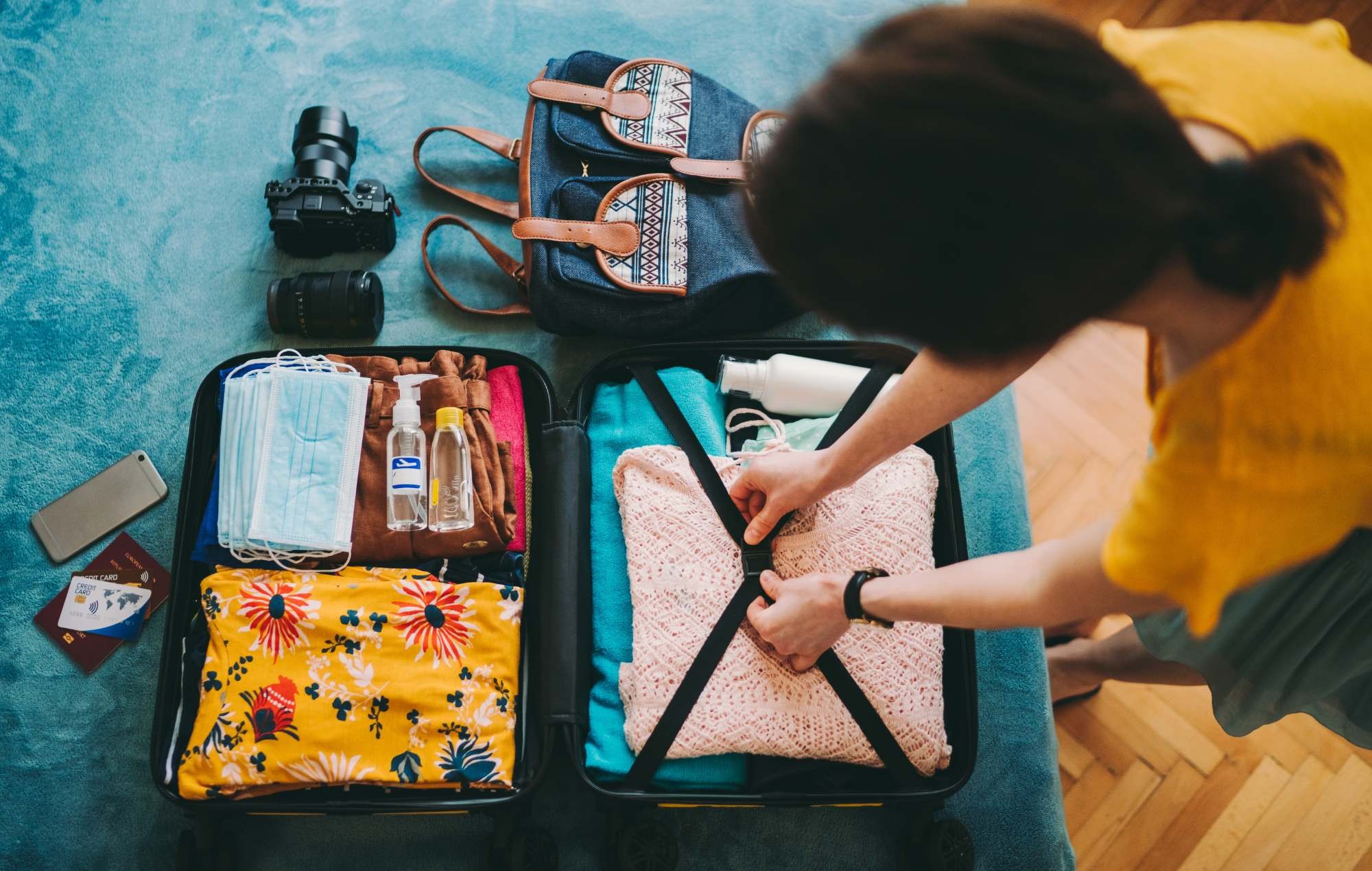
We all want to optimize the way we pack our carry-on and travel light. Yet, we try to bring all our essentials and avoid unnecessary purchases. So we pack every inch of our carry-on. But how large can it be? Can I take only one? Why do some people carry two?
Most airlines allow passengers to take one carry-on for free, plus a personal item.
A personal item is usually a laptop bag, a small backpack, a briefcase, a purse, a camera bag, etc. These typically have to fit under the seat in front of you inside the plane. Personal item limits are slightly different as they are determined by the airline depending on the plane size.
A carry-on can be any piece of luggage — from a rolling suitcase to a large backpack. It goes into the overhead bin once you get on the plane. Size limits for carry-on items vary so it is wise to check size restrictions carefully when you are booking your ticket.
Why are personal item/ carry-on restrictions important?
If your carry-on does not fit the restrictions, you may have to part with it. It will have to go into the hold with the checked bags, which means you’ll have to pay hefty extra fees. Checking carry-on restrictions is especially important for passengers on connecting flights traveling with airlines that have different carry-on restrictions.
Baggage allowance can vary according to the ticket category (business class or economy, flexi, etc.), passenger status (frequent flyer member), even your destination (domestic or international). Baggage policy should be clearly stated on the website of your airline. You can also check the specific rules for your flight during the booking process. You will also be offered different upgrade options to choose from.
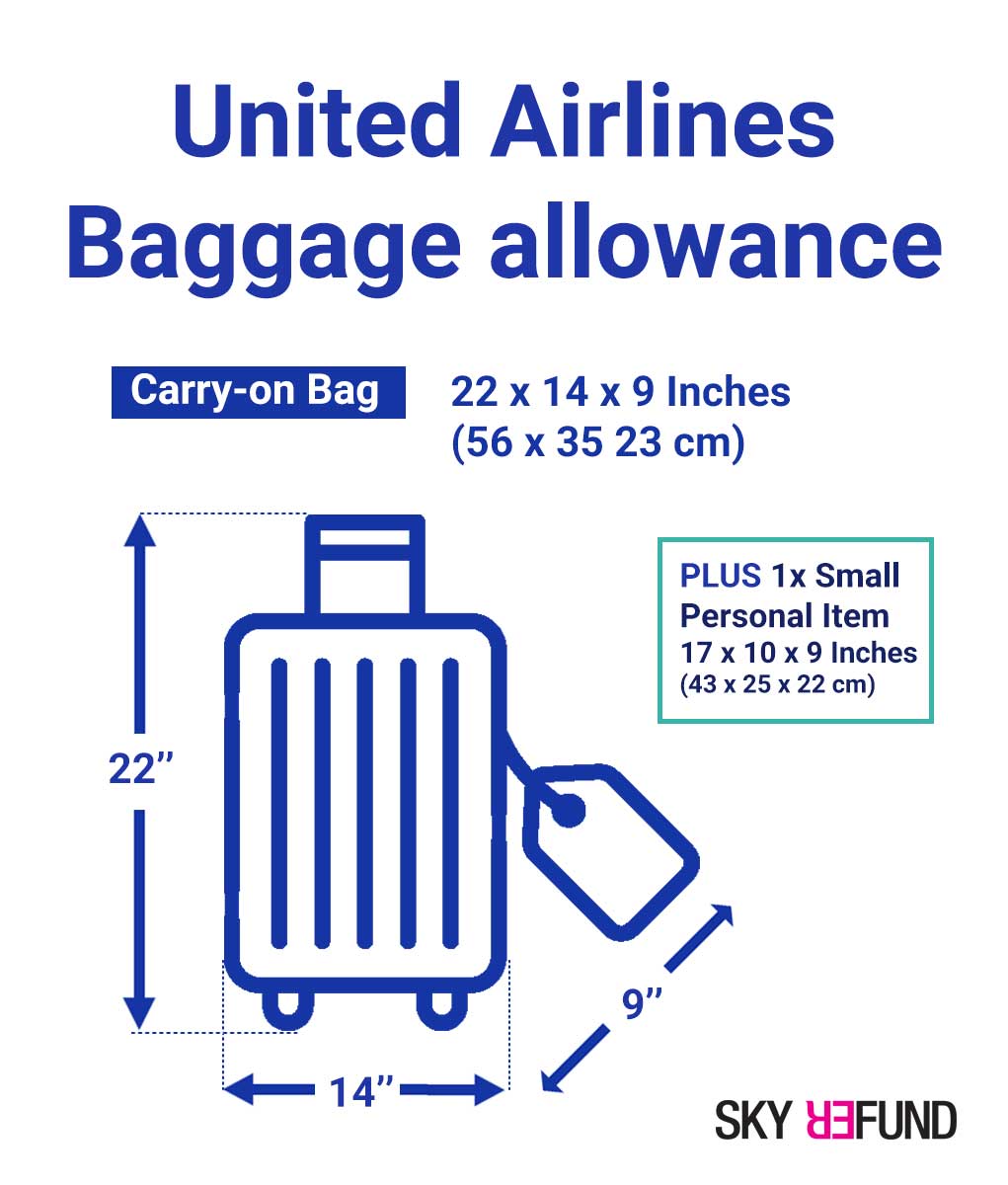
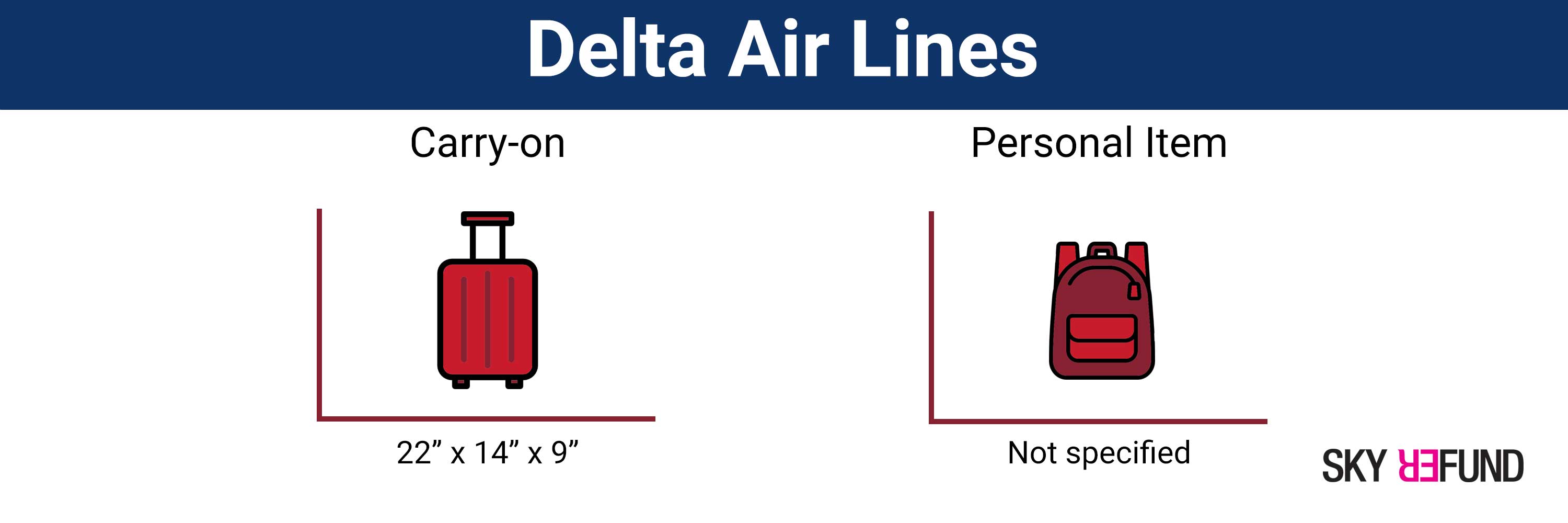
Regarding carry-on weight and size limits, no unified standard exists. The International Air Transport Association (IATA) offers a general guide with the following restrictions for carry-on items: a maximum length of 22 inches (ca. 56 cm), width of 18 inches (ca. 46 cm) and depth of 10 inches (ca. 25 cm). Note that these dimensions include handle, wheels, side pockets, etc. However, the common carry-on restrictions of most major US airlines are slightly smaller: 22 in (56 cm) x 14 in (35 cm) x 9 in (23 cm). Some airlines even enforce weight restrictions on both a carry-on and your personal item.
Most major US airlines limit the size of your carry-on to 45 inches (ca. 114 cm) in total (combined length + width + height of your suitcase/ bag). Some airlines also enforce a weight limit on carry-on items. Others limit the size of your personal item to make sure it fits safely under the seat in front of you.
Baggage allowance with JetBlue depends on the fare.
Basic Blue passengers, for example, are allowed a free personal item but cannot bring a carry-on bag on board.
On the other hand, travelers who have paid the Blue, Blue Extra, Blue Plus, and Mint fares are allowed both a carry-on and a personal item. All personal items must fit under the seat in front of you, whereas carry-on bags can also be stowed in the overhead bin.
Passengers are allowed:
Southwest Airlines is a bit more generous with its carry-on size limit — 24 × 16 × 10 inches (approx. 61 × 40 × 25 cm). Virgin Atlantic, on the other hand, limits carry-on bags to 22 lbs (10 kg). Rules vary and change with time so it is always a good idea to check the airline website, and your booking for details.
Most traditional air carriers usually allow 1 free carry-on plus 1 free personal item. Size limits vary according to the airline.
Low-cost airlines typically charge for a carry-on and allow only an under seat bag free of charge. This backpack or bag must be small enough to safely fit under the seat in front of you.
1 cabin bag (55×40×23 cm) with a maximum weight of 8 kg.
1 cabin bag (55×40×23 cm) with a maximum weight of 8 kg (17.5lbs).
Air carriers are required to state clearly their baggage policy on their website. Note that baggage allowance varies with the fare, destination, etc. so check your booking for details.
Here is a comprehensive list of airline luggage restrictions presenting sizes in inches, centimeters and pounds/ kilograms for about 30 major air carriers.
The second carry-on challenge at the airport is the security screening process. Make sure you know what you can or cannot pack in your carry-on to avoid any hassle.

For security reasons, passengers are allowed to carry a limited number of liquids in their hand luggage. All liquids, aerosols, gels, creams, and pastes are limited to 100 ml (3.4 ounces). Passengers must pack all 100ml bottles in a single transparent resealable bag. Each passenger is allowed 1 bag of tiny toiletry.
As many as you can fit in your 1-liter/ quart-sized bag (approx. 20×20 cm). Note that the bag must be safely and easily sealed and cannot be tied at the top. If any of your precious tiny bottles does not fit, you must leave it at home.
Yes, it does. The liquids' category also includes cosmetics, like gels and creams, aerosols (body or hair sprays, etc.) and pastes (toothpaste, or even any paste-like food, for example mustard).
Note! Containers larger than 100ml must go into your checked luggage (even if the liquid content is less than 100ml).
Liquid rules are about to change with the introduction of new state-of-the-art scanners at airports. The new equipment has already been introduced at several airports in the UK and can safely distinguish between different types of organic liquids (explosives from fizzy drinks). With the introduction of the new 3-D scanners passengers will be allowed to bring containers of up to 2000 ml (2 liters) in their carry-on luggage.
All medically necessary liquids for personal use and necessary for the journey are allowed on board. Make sure you have your doctor’s note or prescription at hand as the security staff may want to check it. The name on the prescription must match the name on the boarding pass.
Yes. All types of baby food, formula, bread, milk, water, juice, etc. are allowed on the plane. You can take as much baby food as you need for the journey. Check out our guide on bringing food on a plane to learn more about the carry-on restrictions around food items.
All passengers are allowed to bring liquids larger than 100ml in the cabin (for example alcohol, perfume, soft drinks, etc.) if:
For security reasons, several everyday items are not allowed on a plane, such as:
Apart from their tiny toiletry (1-liter resealable bag filled with 100-ml bottles), their medication/ baby food and the duty-free products, passengers are allowed to bring in their carry-on:
 English (UK)
  English (US)
  Deutsch
  Français
  Español
  Italiano
  Ελληνικά
  Български
  Srpski
  Português
  Türk
Türk  Русский
  Polski